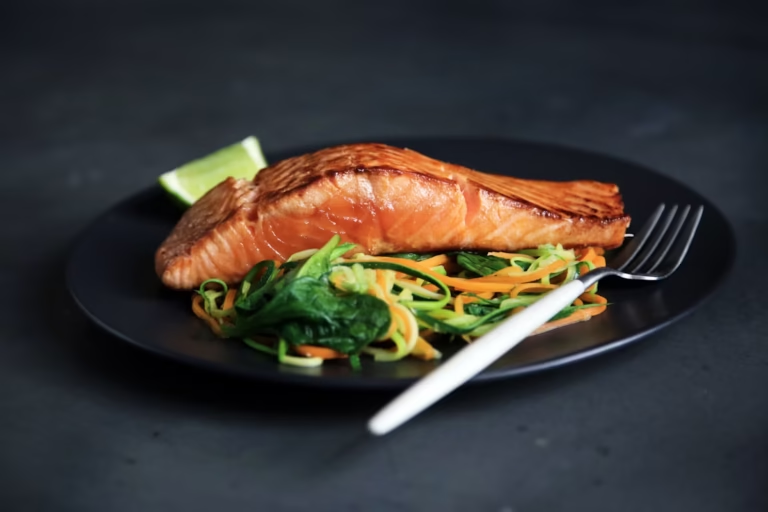
Crispy Pan-Seared Honey Garlic Glazed Salmon
Shatter-Crisp Skin, Tender Flaky Flesh & Sticky Caramelized Honey-Tamari Butter Reduction
The secret to restaurant-quality pan-seared salmon lies in thermal control and moisture elimination. By desiccating the fish skin with paper towels and conducting 75% of the cook time skin-side down under gentle pressure, you achieve an ultra-crisp skin that protects the delicate heart of the fish from overcooking. Finished with a foaming clover honey, raw garlic, and cold butter pan glaze that caramelizes in just 120 seconds.
Curated by Chef Andrea Lin
Pacific Seafood Specialist & Culinary Chemist

The 3 Scientific Keys to Shatter-Crisp Salmon Skin
Pan-seared salmon is notorious for two major pitfalls: rubbery, soggy skin and dry overcooked flesh. Achieving a glass-crisp crust with a tender, translucent medium core depends on three food chemistry principles:
Required Culinary Tools
Pan-Seared Honey Garlic Glazed Salmon
Prep: 10m • Skillet: 10m • Total: 20m • Yield: 4 fillets • 415 kcal/fillet
Ingredients Checklist (Check off as you prep)
Step-by-Step Culinary Method
Desiccate Salmon Skin & Season Flesh
Remove the salmon fillets from refrigeration 15 minutes before cooking so the muscle fibers relax. Take dry paper towels and firmly press against both sides of each fillet. Run the back of your chef's knife down the skin to squeegee out excess moisture, then wipe dry again. Season only the flesh side generously with 0.5 tsp kosher salt and 0.25 tsp freshly cracked black pepper.
Chef's Science Tip: Why We Don't Salt Skin Early
Salt draws moisture to the surface via osmosis. If you salt fish skin 10 minutes in advance, it pools with liquid and turns soggy in the pan. Season the skin immediately before dropping it into hot oil, or season only the flesh side.
Preheat Skillet to Shimmering Point (2 Mins)
Place a 12-inch heavy skillet over medium-high heat. Add 1.5 tablespoons of high-smoke-point avocado oil. Swirl to coat the bottom and heat for 2 minutes until the oil shimmers with faint wisps of steam. The pan must be thoroughly hot before the fish touches it to prevent sticking.
75% Skin-Side Down Sear (4 Mins)
Carefully lay the salmon fillets skin-side down into the hot oil away from yourself to prevent oil splatters. Immediately press down with your fish spatula across each fillet for 10 seconds. Sear undisturbed over medium heat for 4 minutes. Watch the side of each fillet: you will see the opaque cooked color creep up 75% of the side while the skin crisps into golden glass.
Flip, Add Glaze & Baste with Butter (2 Mins)
Gently flip fillets flesh-side down with your fish spatula. Lower the heat to medium. Immediately pour in the whisked mixture of 1/3 cup raw honey, 3 tbsp tamari soy sauce, minced garlic, and 1.5 tbsp apple cider vinegar directly into the pan. Drop in the 2 tablespoons of cold cubed butter. As the sauce rapidly foams, continuously spoon the hot glaze over the fillets for 2 minutes until sticky and caramelized.
Rest Salmon & Finish with Sesame & Scallions (3 Mins)
Remove the pan from heat when the internal temperature registers 125-130°F (52-54°C). Transfer the fillets skin-side down to warmed plates or a serving platter. Drizzle remaining thick pan glaze over the top. Let the fillets rest for 3 minutes so the juices settle throughout the flakes. Scatter with sliced green scallions, toasted sesame seeds, and fresh lemon slices.
Masterclass Culinary Video Guide 4:40 4K UHD
The Science of Glass-Crisp Skin & Caramelized Honey Glaze
Click play or select any chapter timestamp below
Nutritional Profile (Per Fillet)
Calculated for 1 center-cut fillet (approx. 210g with glaze)
View detailed micronutrient breakdown (selenium, potassium, sodium)...
Dietary Variations & Alternative Cooking Methods
Certified Gluten-Free
Standard soy sauce contains brewed wheat. Replace with 100% whole-bean San-J Tamari or coconut aminos. Coconut aminos are slightly sweeter, so reduce honey by 1 tablespoon to maintain balance.
Celiac FriendlySpicy Sriracha Glaze
Whisk 1.5 tablespoons of sriracha hot chili sauce or gochujang into the honey garlic mixture before adding to the pan. Garnish with fresh red Thai bird's eye chili rounds for a fiery kick.
Sweet & FieryAir Fryer Method
Preheat air fryer to 400°F (200°C). Air fry dry salmon skin-side up for 7 minutes. Simmer glaze in a small saucepan on the stove for 2 minutes, then brush generously over salmon and air fry 2 minutes more.
9-Minute CrispyKeto / Low-Carb Swap
Swap raw clover honey for sugar-free allulose honey substitute or monkfruit liquid maple syrup. Allulose caramelizes identically to natural fructose without raising blood glucose.
2g Net CarbsCulinary Chemistry: Fructose Caramelization & Albumin Control
Why does honey produce a richer glaze than white granulated sugar? Honey is comprised predominantly of fructose (approx. 40%) and glucose (30%), whereas cane sugar is sucrose. Fructose begins caramelizing at a lower temperature of 230°F (110°C), compared to sucrose at 320°F (160°C). This allows the glaze to develop a deep amber lacquer in under 2 minutes without burning.
Furthermore, that unappealing white gunk that often oozes out of cooked salmon is albumin—liquid protein that coagulates when muscle fibers contract too rapidly from excessive heat. Cooking the salmon gently on its skin side and finishing off-heat completely eliminates albumin leakage, leaving the flesh glossy and succulent.
Culinary Troubleshooting & Common Pitfalls
Why did my salmon skin stick to the skillet and tear off?
Two causes: either the pan/oil was not hot enough when you laid the fish down, or you attempted to move the fillet too soon! Protein bonds initially stick to stainless steel and cast iron, but as the skin desiccates and crisps, it naturally self-releases from the pan surface. If it resists your spatula, leave it alone for another 45 seconds.
Why did my minced garlic taste bitter and turn black?
Garlic has high natural sugars and minuscule mass; it burns in under 30 seconds if tossed into dry hot oil. In this recipe, garlic is added after the salmon is flipped, submerged into the honey-tamari-vinegar liquid and foaming butter. The liquids keep the garlic under the scorch threshold while infusing the glaze with sweet roasted notes.
How do I know when the salmon is cooked without a thermometer?
Press the top flesh gently with your finger. If it feels squishy, it is still raw. When it gives slightly and you can feel the individual flake layers begin to separate (known as "feathering"), it is at medium-rare (125°F/52°C). Pull it immediately—carryover heat during the 3-minute rest will finish cooking it to tender perfection.
Sommelier Pairings, Meal Prep & Leftover Revival
Chef's Private Cooking Notes
Record your personalized modifications (e.g., used wild sockeye fillets, swapped honey for maple syrup, added chili oil). Notes save automatically in your browser's private local storage.